Tags: style
The Listen But Don't Look Principle
By Mr. Moderator on Aug 20, 2010
Following some recent comments regarding a couple of Townspeople's distaste for Cheap Trick, BigSteve suggested the following advice:
It's too late for y'all to get Cheap Trick, but, as with Herman's Hermits, they're a great example of the 'listen but don't look' principle.
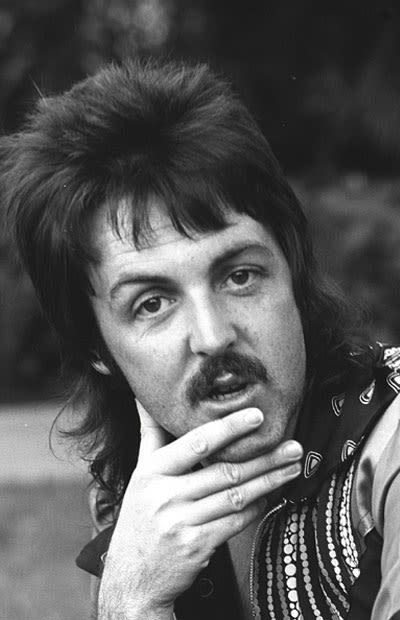
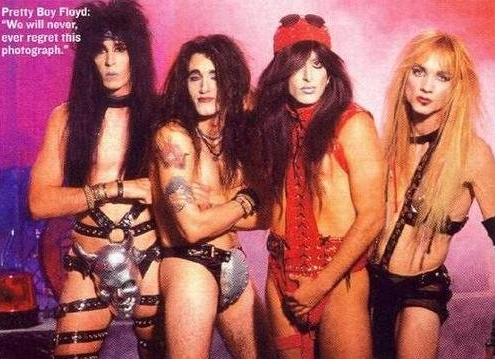
The listen but don't look principle should be of assistance for Townspeople who can't get past a variety of visual beefs: from silly stage wear and goofy antics to the vagaries of aging and genetics. Think of all the artists whose music might benefit from the application of this principle in your own listening life. Certainly this principle has its limits, but BigSteve may be onto something. This may be why some of us find rock 'n roll most enjoyable when holed up in a dark room, alone and listening to recorded music.
Musicians Who Somehow Managed to Have a Bad Look in the 1960s
By Mr. Moderator on Jul 16, 2010
In this morning's wee hours, while driving back from a show in Hoboken, NJ, my close personal friend, Townsman andyr, posed an interesting question from the passenger's seat: Did any musician beside Bill Wyman manage to have a bad Look during the 1960s? I think a number of you would agree with us that the decade offered a variety of sound rock fashions, covering all body types, hair textures, and ethnic and racial groups. Even hulking, pasty, butterscotch-toned Animals' bassist Chas Chandler managed to develop a good Look in the '60s. Wyman, however, never came close to finding a style that worked for him, or should I say us (he and his 10,000 jailbait road conquests managed to cope with that bad Look). (andyr went on to lament that Wyman carried his bad Look into the '70s, like a sexually transmitted disease, eventually infecting his once super-cool bandmates, but that may be for another discussion.)
You've (not) got the look OR If looks could kill
By ladymisskirroyale on Jun 28, 2010
The other night, Mr. Royale and I went to see Pavement at the Greek Theater in Berkeley. As we were waiting during that lag time between the opening band and Pavement, a disheveled, rheumy, older man wearing a black sock, a white sock, and pathetically patched pants approached us. He stood in front of our group and stared at us. Eventually, he pointed to Mr. Royale's equally ripped jeans and slowly drew a sewing kit out of his pocket. He offered it to us, telling us that he was the drummer for Pavement. He asked if we believed him, and we replied that we did not. Instead, I was thinking, this is Berkeley and all that, but how did the homeless dude get in to the show? Later, during the encores, Gary Young scampers up on stage, and we recognize our man. Could he keep the beat? Negotiable. Did he drop the sticks regularly? Certainly. But there was no doubting that the anti-sartorial gentleman was indeed playing drums with Malkmus et. al.
In turning the tables on the theme of The Look, what happens when there is a band member who does not "match" and does not reflect the signifiers of the rest of the band? What are some other examples of this? As many Hall members are also musicians, did you choose or throw out members due to their Look? From previous RTH discussions, it appears that nose hair, clothing, and other visual symbols make or break band cohesiveness, so I welcome your comments and observations.
Rock's Most Significant Haircuts
By Mr. Moderator on May 28, 2010
My wife was telling me about some lame NPR piece she heard that started with news of Willie Nelson cutting his trademark long, braided hair. The news turned into a piece, she said, by some "kid" on most significant celebrity haircuts, or something like that. My wife thought it could be a fun story, but she was quickly put off by the correspondent's reference to "back in the '90s" and a description of Jennifer Aniston cutting off her long hair into a "layered bob." This term really bugged my wife. "A 'layered bob?!?!'" she complained, hours later. "How did this woman not know what a shag is, and if she's some culture correspondent why didn't she refer back to someone like Carol Brady?" She went on to tell me that the woman thought every celebrity hairdo was some variation on a bob. Keri Russell's shocking pixie haircut, for instance, was described as a "short bob." At least the correspondent, according to my wife, did more than talk out her ass on Russell's haircut, telling the story of her old tv show's massive ratings dip following the haircut.
It was clear what my wife was getting at: This was a topic that needed to be discussed by the discerning minds of Rock Town Hall! So let's keep it in the music realm, which we know and love best, and let's get back to the beginning, considering the significance of Willie Nelson's newly shorn locks. What are the most significant mid-career haircuts in rock? How did these haircuts change an artist's fortunes, for better or for worse? How did these haircuts, perhaps, change the course of rock 'n roll? Feel free to riff. We might uncover some important stuff.
All haircuts up for discussion must have taken place after the artist had already established his or her career. In other words, The Beatles' groundbreaking moptop 'do does not qualify because it was not a mid-career change in coiffure.
Rock's Unfulfilled Fashion Ideas: The Jumpsuit
By Mr. Moderator on May 25, 2010
This clip, which Townsman dbuskirk shared with some of his close, personal friends this morning, brought back memories of some of Hall & Oates' lesser, pre-pastel '80s hits, but what stood out most for me was Daryl Hall's blue jumpsuit.
As the results of a solid 2 minutes of research indicate, Elvis Presley first donned the jumpsuit in 1969. Was this the first time the jumpsuit entered the world of rock 'n roll? A piece on a 2007 Graceland exhibit on Elvis' jumpsuits notes that the Elvis jumpsuit was originally a 2-piece ensemble, inspired by The King's karate wear. As he prepared for his Las Vegas stint following the legendary '68 Comeback Special, Elvis saw the jumpsuit as a more-interesting alternative to the standard tuxedo favored by "square" performers.
He was going there to rock. Wanting something different and special, he called upon Bill Belew, who had designed the now-classic black leather suit and other outfits for the '68 special. Inspired by Elvis' great interest in karate, Belew came up with simple two-piece gabardine suits with tunic-style tops and simple, long karate-style belts knotted to one side with the ends dangling from the hip.
It turns out that Elvis didn't wear the actual 1-piece jumpsuit - which we all would agree is the mark of a true jumpsuit - until his 1970 Vegas run. For the record, therefore, it was not Elvis who introduced the jumpsuit to rock 'n roll, but perhaps this guy:
Rock's Unfulfilled Fashion Ideas: Athletic Wear...Confirmed
By Mr. Moderator on May 13, 2010
Stone-cold Winner Rock! Even athletes had the good sense not to don athletic wear when rocking out.
Rock's Unfulfilled Fashion Ideas: Athletic Wear
By Mr. Moderator on May 12, 2010
As a seemingly rare rock 'n roll lover who sees (and, yes [sadly], seeks) connections between music and sports - and as an observer of and sometimes participant in rock style - I've long been fascinated by rockers' attempts at bringing athletic wear onto stage. To date the merging of athletic clothing and rock 'n roll has not taken root, although rap/hip-hop artists have succeeded beyond any sports-and-music fan's wildest desires, ranging from track to football field to the hardwood. Hip-hop artists have even worked in the popular athletic gear with perhaps the highest degree of difficulty of incorporating into rock 'n roll style (or style anywhere off the playing field for that matter): the baseball jersey.
But we're here to talk about athletic wear as one of rock's unfulfilled fashion ideas. Sorry to stoop to Rockism, but let's not kid ourselves: rock 'n rollers have not had much success in this realm. It's important that we focus on rock 'n roll artists who've attempted bridging this divide and see if we can't figure out whether there is any reason for future rock musicians to pursue this concept.
RTH, Idol Thyself!
By hrrundivbakshi on May 1, 2010
This is where we show our exquisite taste in haberdashery and personal grooming, indicating just what we would do with our Look, if we were to enjoy the same (presumably) unexpected mega-stardom enjoyed by the Kings of Leon. KoL chose, for whatever reason, to dump their dope-smoking, white-trash hillbilly Look (the one that so pleased "authenticity"-starved British rock critics a few years ago), in exchange for slick, Randy Jackson-approved, AmIdol garb, hair and grooming.
But what would *you* do? And while we're at it: which current or past rock personalities dressed with the kind of style and panache that matched your high expectations of a *rock star*?
I look forward to your responses.
HVB