I’m sure you’ve all read some critic’s unexpectedly high-brow take on what’s generally considered a low-brow song or album, such as a thesis-length review of Loverboy‘s “Working for the Weekend”, which argues that that humble song’s lyrics are more meaningful and artistically honest than, say, John Lennon’s “Working Class Hero”. Chances are, you Deep Thinkers in the Halls of Rock have secretly harbored your own unexpected insights into what’s typically considered throwaway pop. Isn’t it high time you come clean and share these thoughts, thoughts which may not play at the water cooler or a cocktail party?
Veterans of the Halls of Rock may recall our enthusiastic, hard-working sessions discussing the working definition of Proctomusicology and that aesthetic discipline’s resulting music, Prock. The goal was to develop a validated, universally accepted notion of these terms, which could be used to shift the paradigm of rock criticism. Alas, we may have crawled up our own collective ass. Another post or two would follow this Working Definition, but eventually Townspeople threw up their hands and were content to use the term “Prock” without fully understanding its full implications. Perhaps revisiting this topic will inspire new research and debate. Perhaps not.
This post initially appeared 2/26/07.
Before a term makes it to the Rock Town Hall Glossary, it must first be identified and understood. A few weeks ago, we began work on defining the term Proctomusicology and its related terms Proctomusicologist and Prock. In the course of our investigations, it was determined that Prock, as a musical subgenre, might be the missing link that will unite previously segmented artists across rock subgenres.
During our initial examination, bands such spanning as wide a spectrum as Steely Dan, Apples in Stereo, XTC, Jellyfish, Adrian Belew-era King Crimson, Paul Simon, and Lindsey Buckingham were suggested as possible practitioners of Prock. Along the way, we tried to determine what united these musicians, what characteristics both they and their fans might have had in common.
One characterization of Proctomusicology and Prock practitioners, as offered by a Townsperson, that we could agree on was as follows:
Music that’s almost exclusively built on styles and attitudes fom Rock’s past, without making any claims of overt revivalism.
There was also the suspicion that Prock music is, as one Townsperson put it:
Among your circle of friends or loved ones, is there a particular album by an artist they typically like as much as you that they do not like whatsoever?.
For instance, in my Elvis Costello-loving household, we agree on all the worthwhile Costello albums to be spun, with only two exceptions. The first exception is Punch the Clock. My wife bemoans the fact that she can’t play Punch the Clock in my presence (and I’ve shielded my boys from hearing it to date). However, she is willing to accept that fact that it’s a “chick album.” This kind of statement from my usually wouldn’t fly with her for good reason, but the last time the topic came up and I said, “That album should have been released with a Ladies Only sticker” she didn’t object. I suspect The Great 48 ranks it among Costello’s best works, but does any other guy play that album if a woman’s not around?
The other Costello album that we don’t agree on as a family is Trust. Any time I put that album on, whether at home or in the car, my lovely wife says, “What’s this?”
“You’ve been asking me, ‘What’s this?’ for 20 years,” I’ll reply. Now, over the last few years, as my boys have begun flexing their rock nerd muscles, they’ll chime in:
“Why don’t you play a good Costello album?” my oldest son said last week.
“What kind of song is this?” my youngest son tacked on as “Watch Your Step” got under way.
What’s wrong with my family? When are they going to dig this album, already? Let me be clear: there are artists and albums we don’t agree on, and that’s fine. My wife will forever think The dB’s sing like pussies, and she’s welcome to her opinion. She can spot Richard Thompson, even on the Fairport Convention songs he doesn’t sing lead on, from a mile away. I’m cool with not spinning that stuff until everyone’s out of the house. My boys object to some albums my wife and I love, like Crowded House’s Together Alone, and that’s cool too. We’re a family. We can work it out. When it comes to Trust, however, something’s out of whack.
Whenever I do try to slip this album under their radar I spare them the two worst songs of Costello’s great era: “Luxembourg” and “Shot With His Own Gun”. Isn’t that big of me? I can see how even diehard Costello fans might find Trust a little spotty, especially sandwiched between Get Happy!! and Imperial Bedroom, but can’t my wife and kids appreciate the excellent drum and bass sound and arrangements, as I do to get me through the lesser songs (the two outright turds excepted, which I skip at all costs)? Come on, family, Trust has as much to offer on long car trips as a lot of other albums we agree on!
Do you ever face a similar difficulty in getting your friends or loved ones to accept an album they have no business not liking by an artist they otherwise love?
When I was in high school, digging the hell out of Elvis Costello & The Attractions, the release of Taking Liberties was a big deal. As if the guy hadn’t been cranking out enough action-packed releases, his record label, Columbia, graciously collected 20 additional songs that had been floating around on UK import versions of his albums and B-sides, or that had been stored away on a shelf, previously unreleased! Getting all these “odds & sods,” to use the title of The Who’s mid-70s collection of spare parts, in one package, for one affordable price was the way to go for a kid with limited pocket money in days long before the hope of file sharing and the rise of the mighty Apple Empire. Check out what my $5 or so bought in 1980:
Side one
“Clean Money” (previously unreleased)
“Girls Talk” (b-side of “I Can’t Stand Up For Falling Down,” 1980)
“Talking in the Dark” (a-side, 1978)
“Radio Sweetheart” (b-side of “Less Than Zero,” 1977)
“Black and White World” (Demo version) (previously unreleased)
“Big Tears” (b-side of “Pump It Up,” 1978)
“Just a Memory” (b-side of “New Amsterdam”, 1980)
“Night Rally” (from UK version of This Year’s Model, 1978)
“Stranger in the House” (a-side, 1978)
“Clowntime Is Over” (Version 2) (b-side of “High Fidelity,” 1980)
Side two
“Getting Might Crowded” (b-side of “High Fidelity,” 1980)
“Hoover Factory” (previously unreleased)
“Tiny Steps” (b-side of “Radio, Radio,” 1978)
“(I Don’t Want to Go to) Chelsea” (a-side, 1978)
“Dr Luther’s Assistant” (b-side of “New Amsterdam,” 1980)
“Sunday’s Best” (from UK version of Armed Forces, 1979)
“Crawling to the U.S.A.” (from soundtrack to Americathon, 1979)
“Wednesday Week” (b-side of “Talking in the Dark,” 1978)
“My Funny Valentine” (Richard Rodgers, Lorenz Hart) (b-side of “Oliver’s Army,” 1979)
“Ghost Train” (b-side of “New Amsterdam,” 1980)
That’s a better album than a lot of artists ever release as one of their primary works. It’s a better album than Costello himself has released in ages. It was also a lot of fun to read the liner notes and spot guest musicians (Quick: Who recalls the track on which The Clash’s Mick Jones plays – and how cool was it the first time to see his name listed in the credits?) or instances of Costello playing his own bass parts. Back then, that side of Elvis was still fun.
Today, on our eighth digital reissue cycle of the Costello catalog, these tracks are scattered as bonus tracks, with German import-only B-side and, in most cases, rightfully previously unreleased tracks added. Although I appreciate being able to taste more of Elvis’ table scraps from his glory days, I miss the simplicity of Taking Liberties, which is not, I believe, in print as a stand-alone CD.
Taking Liberties, Odds & Sods, Dead Letter Office… Whose fridge have you most taken pleasure in raiding through one of these collections?
I’m not sure I have an adequate example yet–U2 was the first band that came to mind for me, although they’d gradually went from “pretty cool” to “completely annoying” by the time of that Rattle and Hum movie. I also recall a lot of people thinking Duran Duran were hip when they came out, but after a brief spell of them getting an appropriate critical wedgie, they seem to have regained their slightly hip standing. Go figure.
What I’m looking for are artists who came out of the gate hipper than hip who then had a steep, sudden dropoff in hipster quotient. Painfully slow declines, such as the decades-long dropoff in hipness experienced by the Jefferson Airplane to Starship, are NOT what I’m looking about. (I know, Dylan’s line, “You ain’t got nothing when you’ve got nothing to lose” may spring to mind among Airplane hatas.) And this isn’t about “quality” or the jumping of sharks, necessarily. I might argue, for instance, that The Boss‘ quality shot up for a stretch while he went from hipster underground artists to mainstream rock icon.
Oh man, I just thought of a perfect example: that band from upstate New York that featured Natalie Merchant! Thankfully I’ve blanked out their name, but how many of you thought they were hip when they were opening for REM, and how quickly did they fall from hipster grace?
In the last week we were reminded of The Great 48‘s admission that he’s yet to hear John Lennon’s Plastic Ono Band album. We also learned that Hrrundivbakshi was just aboutt to pop his Four Seasons’ Genuine Imitation Life cherry. If you’ll recall, HVB even found an old quote from John Lennon, who praised the album at the time of its release.
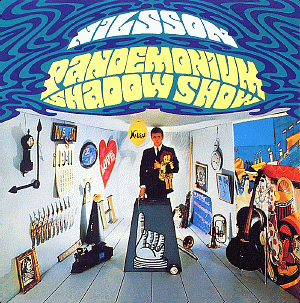
Speaking of albums Lennon (and McCartney) praised, just a few minutes ago, while researching another possible topic, I was reminded that I’ve never heard Nilsson‘s debut album, Pandemonium Shadow Show. The album cover alone should have been reason for me to check out this album, but I’ve long been afraid of digging too deeply into anything by Nilsson. Don’t ask me why; I’m not sure that I understand it myself, although his album of Randy Newman covers helped me finally give Newman a fairer shake.
We rightfully pride ourselves on our dedication to knowing all there is to know about all that’s worth knowing in rock ‘n roll. We need to know these things to conduct the high-level, in-depth discourse that brings us to the Halls of Rock. However, I’m sure we all have a shocking gap in our accumulated rock knowledge. This is your chance to step forward and confess to not ever having heard an album over which rock nerds typically take pride in flaunting their educated opinion.
Yes, I’ve long been curious to hear this Roy Harper guy. Although I only learned to love Led Zeppelin in my early 20s and although I’ve yet to be anything more than fascinated by the emotional sludge of Classic Pink Floyd, those bands were huge during my formative rock years, and I couldn’t help but feel like I’d missed out on the rock nugget that was Roy Harper. It seems like a lot of you have yet to hear this guy as well, so take your hat off, have a cigar, and check him out as I check him out for the first time.
I found this rare 1966 recording, his first single, on a compilation called The Best of Strike Records. It’s pretty cool, as is the entire compilation.