As we’ve noted before, it’s a wonder what a quick YouTube search inspired by a recent post can turn up.
Continue reading »


As we’ve noted before, it’s a wonder what a quick YouTube search inspired by a recent post can turn up.
Continue reading »

An exceedingly nerdy question to ask, yes, but a worthwhile one, nonetheless, I think. Let’s consider some nominations, shall we?
CHRIS THOMAS
Beginnings: Famously served as George Martin’s understudy during the White Album sessions.
Some Highlights: John Cale’s Paris 1919; Roxy Music’s second, third, and fifth albums; Mixed Dark Side of the Moon; Never Mind the Bollocks; First three Pretenders albums; INXS’ commercial juggernaut Kick; Pulp’s Different Class and This Is Hardcore.
WHAAA? Many interchangeable Elton John albums of the ’80s and ’90s.
JOHN LECKIE
Beginnings: Helped engineer Plastic Ono Band and All Things Must Pass. John Lennon nicknamed him “Licky,” supposedly.
Some Highlights: Be-Bop Deluxe (That’s for you, Mr. Mod.) Early XTC and Dukes of Stratosphere; Three Fall albums, which is more than most members of The Fall can manage (I’m kidding, Berlyant!); First Stone Roses album; Radiohead’s The Bends.
WHAA? Los Lobos’ Good Morning Aztlan
STEVE LILLYWHITE
Beginnings: Engineer somewhere. Does not appear to have learned at the feet of anyone Beatle-related.
Some Highlights: Peter Gabriel’s third album; XTC’s Drums and Wires and Black Sea; many U2 albums; Kirsty MacColl; The Pogues; the last Talking Heads album.
WHAA? Blamed for the big drum sound of the ’80s, but what’s really strange is his alliance with latter-day hippie jam types, particularly Dave Matthews Band.
Greetings, fellow seekers of the weird, the wonderful and the purportedly worthless! As RTH slogs its way through the merits of various over-produced girl groups from the ’80s, ’90s, and beyond, I thought I’d take a moment to showcase a couple of singles I found while scouring the bins at a local flea market.
First up: The Goodees, a girl group signed to Stax’s “Hip” sub-label as a result of winning a local talent contest in Memphis. Some of you might be familiar with their extremely modest hit “Condition Red” — but it was the B-side, “Didn’t Know Love Was So Good”, that really got me. That Isaac Hayes piano stab after the start of every verse — dang! Just goes to show you how one simple part can really make or break a tune.
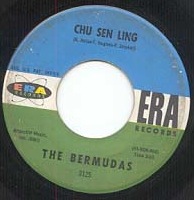
Here’s my second thrifty find of the girlie variety: “Chu Sen Ling”, by oriental girl group The Bermudas. Or… wait. Not an oriental girl group. Turns out, the “Bermudas” — as well as The Majorettes, The Georgettes, Joanne & The Triangles, and Beverly & The Motorscooters — were all fake “bands” created by Los Angeles musical entrepreneur Rickie Page to showcase the talents of her immediate family. I’ll let Spectropop continue the story; it is a fascinating one:
This particular outfit comprised Rebecca (Becky) Page, her older sister Joanna, their mother Rickie and Susie Kuykendoll, Rickie’s sister. Rebecca shared lead vocals with Rickie, whose oldest daughter Sheilah sometimes took her place in photos of the group. In 1957 Rickie Page had begun a stream of recordings using her own name for every label under the California sun, not to mention some in Nashville. She also waxed as a member of the Jordanaires, the Spectors Three and Bobby ‘Boris’ Pickett’s Crypt-Kickers; factors which make her one of the unsung heroines of the early-1960s Los Angeles scene. Rickie is still active in the music business, composing songs from her base in Fresno, California.
Anyhow, for me, the point is: I love this song!
Folks, I’m busy these days, so it’s hard for me to wax philosophic on this kind of thing, but I do have one far-ranging, and hopefully revealing, question for all of you: in one sentence, what purpose do “girl groups” serve?
I look forward to your responses.
HVB
During a recent Last Man Standing thread Townsman cdm proposed a future topic, which we present today: Albums that you are convinced you are the only person to ever have spent money on. For those of you who were taking chances on albums in 1978, the above video may help jog your memory. Since the explosion of indie rock and DIY releases, the opportunities for spending money on an album that no one else has spent money on have expanded astronomically.
As is usually the case, we expect you to do more than simply list these albums. Tell us something about them. What attracted you to actually buying them? Should you worry that your secret will be out and other hipsters will seek out existing copies of this album?
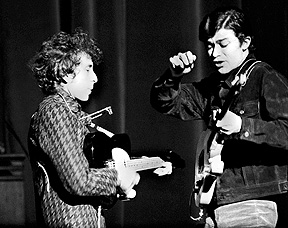
A while back we analyzed the legendary duel in The Last Waltz between Eric Clapton and The Band’s Robbie Robertson. Using cutting-edge technology and the better part of three lunch breaks, we compared the efficacy of Clapton’s Guitar Solos to Robertson’s Rock Faces. This groundbreaking study has led to similar inquiries in development and not yet reported, such as a comparison of the efficacy of Aretha Franklin’s pipes to Mariah Carey’s tits and ass from this legendary VH1 Divas performance.
While this and similar studies are ongoing, I’ve been thinking about the concept of the evolution of Rock Faces. How much of what an artist hits the stage with is owing to God-given talent and how much of an artist’s facial means of communication is developed through hard work and study? I decided to kick off this inquiry with an examination of the evolution of the Rock Faces of The Band’s Robbie Robertson. The conclusions we draw from this analysis are only the tip of the iceberg. In coming weeks, as we discuss these findings and examine the evolution of Rock Faces by other artists, we’ll surely develop a more comprehensive picture.
As you know, many members of what would become The Band backed up Bob Dylan on some of his first electric tours. Here’s a young, studious, respectful Robbie accompanying Dylan on acoustic guitar in a hotel room. In a wholly subservient role, Robbie’s all about respect. The closest he gets to flashing anything remotely resembling a Rock Face, is around 56 seconds into the clip, when he engages in an empathetic head dip in rhythm with the descending chord progression.
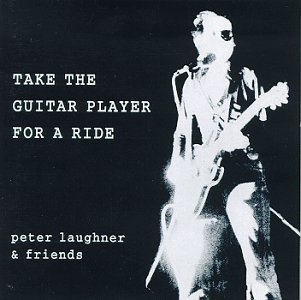
Townsman Tvox, while necessarily donning the Pince Nez for a correction in a recent thread, made this interesting admission regarding a cool cover his old band used to feature:
The Wishniaks used to cover Peter Laughner‘s “Sylvia Plath”. Only we covered the version done by Philly locals The Johnsons. To this day, I don’t think I’ve heard the Laughner version.
I was reminded of how many years passed before I finally heard the original version of “Louie Louie” or even “Twist and Shout”. I did hear the originals eventually, but I’m sure there are still songs I know well in a cover form without ever having heard the original. I’ve got to think about this. How about you? Have you ever had an experience like the one Tvox expressed, whether you’d covered the cover version or not?
The new Mudcrutch album is not the album they would have made in the early ’70s if they had not broken up, but it’s fun to think about it as if it were. Despite its appearance in the celebration of California Day, I’d like to think of it more as a Florida Day kind of album, with a distinct period vibe.
All that makes this album unique is disguised by the choice of the first single off the album, “Scare Easy”. Probably chosen so as not to scare off any of Tom Petty’s fans, this track sounds like it could have been on any of his albums from the last 30 years. As Ed mentioned, it has the “won’t back down” stance, and a very familiar chugging rhythm. It’s not a bad track at all. Au contraire, as they say in Florida. It’s just that it’s not representative of the album as a whole.
Petty’s Byrds influence was apparent from the very first, and it’s there on this album as well. But here we have the Gram Parsons and Clarence White versions of the band to thank, rather than the Feel a Whole Lot Better Byrds. Mudcrutch even covers “Lover of the Bayou” here, a McGuinn/Jacques Levy song from the Byrds’ Untitled album. And with Mike Campbell and Tom Leadon on guitars here, there’s a hell of a lot of guitar picking going on, and the sound often invokes Clarence White’s Telecaster.
However much we think of the Byrds as a California band, most of its members were not from the area. Only Crosby and Hillman were natives. McGuinn was from Chicago, and Gene Clark was from Missouri. And you know where Gram Parsons was from? Florida. He may have felt that Joshua Tree was his spiritual home, but he grew up in Winter Haven, Florida (and also Waycross Georgia). Parsons is definitely a presence on this album, and there are some his quasi-shitkicker style songs here. They also cover the trucker anthem “Six Days on the Road”, which the Burritos also covered.
Lots of people played that one back in the day. I think I first heard it from Taj Mahal. And this album opens with “Shady Grove”, one of those folk songs that was knocked around by lots of bands. It’s on one of those Garcia/Grisman collaborations, but the version here is probably most influenced by the one that was done by the edition of Quicksilver Messenger Service that featured Nicky Hopkins. Very ’70s. I read in an interview that Mudcrutch actually used to play this one way back when.
This album also reminds me that, when Mudcrutch first went out west, they were signed to Denny Cordell’s Shelter Records, and if I remember correctly Petty and the Heartbreakers did some time in Shelter’s Oklahoma studio. Here and there – mostly “This Is a Good Street” and “The Wrong Thing to Do” – this reminds me strongly of another Shelter artist, Dwight Twilley. The same mixture of twang and British beat, but with strikingly different idiosyncratic lead singers.
Another thing that might surprise you if you were expecting a Heartbreakers album instead of a period piece is the jamminess. As I said before there’s a lot of guitar playing, and on the 9:28 long “Crystal River” there’s a LOT of guitar playing – solos with space echo, wah-wah pedal, even phasing. It’s one of those dreamy extended workouts like “Mountain Dew” or “Mountain Jam”. Remember that in the world of the original Mudcrutch, the Allmans would have been a major presence, and there’s even a nod to them on this album’s “Bootleg Flyer”, a dual-guitar lead passage that’s so obvious it will make you smile.
In general the playing here is great. I’m sure Petty is glad he gave up the bass for the rhythm guitar/frontman role, but I bet he’s having a blast playing bass like he used to. Benmont Tench does his thing of never calling attention to himself, but when you do pay attention to what he’s doing you realize how great he is. If you were worried about whether drummer Randall Marsh, who doesn’t have much on his resume besides Code Blue (an L.A. band he was in with former Motel Dean Chamberlain and Gary Tibbs of the Vibrators/Roxy Music), don’t. He sounds fine. Sometimes you recognize Mike Campbell’s licks, but in general you can’t tell if he’s playing or if Tom Leadon is.
The reason Mudcrutch headed to L.A. in the first place was that Tom’s big brother Bernie was doing so well with the Eagles, perhaps the stereotypical L.A. band, none of whose members were actually from L.A. Beside Leadon, Meisner was from Nebraska, Henley Texas, and Frey Michigan, but I guess that’s one of the truisms about L.A., that no one is from there. (And here’s a bit of trivia I found when fact checking that last bit: according to Wikipedia, Frey, in his pre-alpha douche days, played on RTH icon Bob Seger’s “Ramblin’ Gamblin’ Man”.)
So I’m not saying anyone will mistake the Mudcrutch album for a Marshall Tucker Band album, and I’m not even saying that Petty is exploring his southern roots on this album. But maybe the sounds here crystallize the southern basis of Petty’s music that was there all along.


