Jun 252008
 

In 1973, the Stones follow up their most ambitious album, Exile On Main Street, with Goats Head Soup. Exhausted from weeks of all-night sessions and covering for Wyman’s bass responsibilities, Keef takes a virtual leave of absence from the Stones and lets the Micks work out the next album. The big hit single from Goats Head Soup is “Angie”, in which Mick Jagger and the boys take on Rod Stewart in the most mawkish part of Stewart’s game. Big whoop! Are you proud of this effort, Stones loyalists? Stones fans are generally unimpressed. The Stones have entered the period in their history when they’re expected to make the playoffs, when they can’t sell out playoff games on their own turf.

Before moving on, to ensure clarity in the guidelines under which this examination is being conducted, it should be noted that the best song the Stones would record in 1973, the initial tracks for “Waiting on a Friend”, does not qualify for inclusion.

Some time back we discussed Goats Head Soup and how it compared unfavorably to an album beyond the scope of our current investigation, the vibrant, Ron Wood-inspired boys’ club racket of Some Girls. Click here to revisit that post and sample some of the songs from that album, if you’d like. They’re not that good, and they’re pretty lousy by previously established Rolling Stones’ standards.
Faces, “Cindy Incidentally”

Faces, “My Fault”

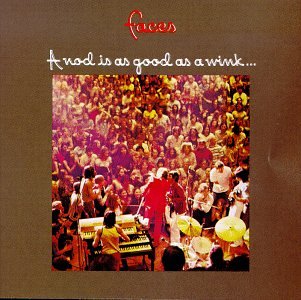
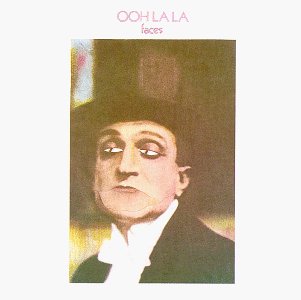
Rod Stewart, wisely, took a year off from releasing a solo album. With Faces, however, he took part in what I believe is the band’s most consistent, emotionally charged album, Ooh La La. Taken as a whole, I liken this album, in the band’s brief existence, to their version of the Klassic Kinks‘ late-60s run. It represents all sides of what made the band, occasionally, great and very little of what made them easy to write off when compared to titans like the Stones. It’s the “smallest” of Faces albums, thanks in large part to Stewart’s limited involvement on lead vocals. However, according to the methods we have set for this examination, we will not consider the great tracks sung by Ronnie Lane (“Glad and Sorry”, “If I’m On the Late Side”, “Flags and Banners”) or Ron Wood (the title track) other than to say that they may not have been heard by all but a few record nerds like ourselves if not for the involvement of the more commercially viable Rod Stewart. I know this will pain some of you, but let’s give it up for the trickle-down effect of Stewart’s marketing clout!
Continue reading »

Share
Jun 252008


After Rod Stewart landed the shocking combo of Every Picture Tells a Story and two vibrant Faces albums in 1971, the Stones retreated to a distant corner in the South of France to gear up for a tougher battle than they’d expected. Jagger had trusted roadie, ivory tinkler, and confidante Ian Stewart cut the sac of blood and other fluids that threatened to close his right eye. Keef took Mick Taylor down to the pub, then chewed him out, telling him to stop dicking around with minor seventh chords. Wyman cruised Arles for a kinky mother-daughter team. Charlie made sure Purdie had his passport in order. The Stones dropped the Satan schtick once and for all, but there would be hell to pay in the form of Exile on Main Street.

Share
Jun 252008
 

In another effort to allow you to ease your mind from Round 3 of our fiercely contested Stewart vs Stones Battle Royale, we seek your candid answers to the following questions. Don’t think twice, it’s all right.

If someone would give you the ticket for free, what band would you most like to see play live solely for ironic reasons?

What musician who came out of the punk era most suffers from Fogerty Syndrome?

In 225 words or less, please explain the long-running, massive appeal of Neil Diamond?

Quick: When you think cut-out bins what’s the first album that comes to mind?

What’s your favorite pre-rock era cover by a rock band?

I look forward to your responses.

Share
Jun 252008
 

Sam Phillips, “My Career in Chemistry”

Sam Phillips, “Don’t Do Anything”

I’m used to Sam Phillips albums being challenging on initial spins. A friend tried to turn me onto her in 1994, playing me Martinis & Bikinis, which he’d just bought. As he suspected, I dug hearing XTC’s Colin Moulding on bass, but the first time I heard it the album was too cluttered and claustrophobic for even my clutter-craving ears. About 2 years later, another friend who’d been trying to turn me onto Phillips and, for years before that, her husband/producer at the time, T-Bone Burnett, came to our house and left my wife and I with copies of both Martinis & Bikinis and a previous album, The Indescribable Wow. “Here,” he said, as he slapped the CDs onto our kitchen table, “it’s time you guys love these albums!”
Continue reading »

Share
Jun 242008
 

Here’s where I expect sparks to fly. The Stones opened Round 1 with a furious set of haymakers. Rod Stewart had his best work stripped from him and added to its proper place in 1970, leaving him nearly defenseless against my favorite post-Brian Jones-era Stones album. However, despite chronological inaccuracies, my writing on Stewart’s early strengths was so strong that I managed to keep him standing and alert when the first round ended. In Round 2, Rod Stewart established his footing and skillfully accumulated points from the judges compared with the Stones’ party-hearty, contractually obligated “live” album. Now, as we enter Round 3, covering the artists’ 1971 releases, both contestants answer the bell looking to score an early knockout!


The Stones release of Sticky Fingers is loaded with radio-ready rockers and the richest ballads they’d displayed to date. There’s “Brown Sugar”, “Wild Horses”, “Can’t You Hear Me Knocking”, and “Bitch” for starters. There’s also the overrated “Moonlight Mile” among other highly regarded deep cuts. That’s cool: we’re all entitled to overrate a deep cut or two per great album.

Despite my never loving the album or feeling the need to own it, Sticky Fingers is a powerfully crafted album – and we’ll want to consider issues of craft in 1971’s tightly fought Round 3 – and the first Stones studio album to prominently feature the fretwork of Mick Taylor – and not an album too soon! As the times demanded extended jams and more stringent blues credibility, Taylor brought chops to the band that were already in place in upstart hard rock bands like Humble Pie and Faces. As great as his work in this period was, Keef wasn’t going to cut it as a lead guitar hero in the post-Altamont landscape.

In setting up this Battle Royale, I pledged to center the examination around the music, at least in the early rounds, but before we move on I’ve gotta give Mad Props to the album cover. Here’s a definite, early advantage for the Stones in comparison with the typically blah album covers associated with most of Stewart’s work during this period.

Now…

CRANK IT UP!

Rod Stewart, “Every Picture Tells a Story”

Faces, “Bad ‘n Ruin”

Rod Stewart, “(I Know) I’m Losing You”

Then…

Share
Jun 232008
 

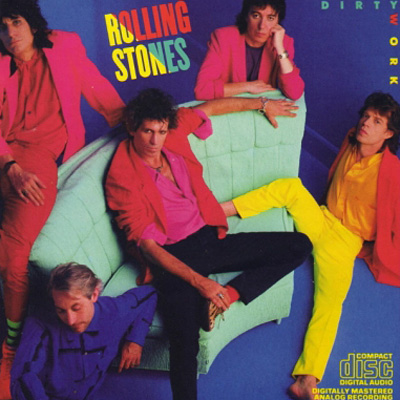
While the Rolling Stones continue to battle Rod Stewart and the Faces in the 1970s and once more find the merits of their later work in question in the Rock Town Hate thread, this seems as good a time as any to take a closer look at the oft-maligned cover of their 1986 Dirty Work album.

They come in colors...

As photographed by Annie Leibovitz, the Dirty Work cover could be viewed as testament of what had gone wrong for the Stones. Lounging about in garishly bright outfits, the band seemed to embody the ideas of 1980s excess and lack of taste. Indeed, this was something of a sign of the times, as the band photo was reportedly a record label mandate, and Dirty Work may have been the first Stones album to be released on both vinyl and compact disc.

Though perhaps not the most popular album cover in the Stones’ catalog, Dirty Work does stand as not just a symbol of the times, but also a commentary on the band itself. As someone once sang, every picture tells a story.
Continue reading »

Share

Lost Password?

 
twitter facebook youtube