Courtesy of HVB.


Courtesy of HVB.
Here’s where I expect sparks to fly. The Stones opened Round 1 with a furious set of haymakers. Rod Stewart had his best work stripped from him and added to its proper place in 1970, leaving him nearly defenseless against my favorite post-Brian Jones-era Stones album. However, despite chronological inaccuracies, my writing on Stewart’s early strengths was so strong that I managed to keep him standing and alert when the first round ended. In Round 2, Rod Stewart established his footing and skillfully accumulated points from the judges compared with the Stones’ party-hearty, contractually obligated “live” album. Now, as we enter Round 3, covering the artists’ 1971 releases, both contestants answer the bell looking to score an early knockout!
The Stones release of Sticky Fingers is loaded with radio-ready rockers and the richest ballads they’d displayed to date. There’s “Brown Sugar”, “Wild Horses”, “Can’t You Hear Me Knocking”, and “Bitch” for starters. There’s also the overrated “Moonlight Mile” among other highly regarded deep cuts. That’s cool: we’re all entitled to overrate a deep cut or two per great album.
Despite my never loving the album or feeling the need to own it, Sticky Fingers is a powerfully crafted album – and we’ll want to consider issues of craft in 1971’s tightly fought Round 3 – and the first Stones studio album to prominently feature the fretwork of Mick Taylor – and not an album too soon! As the times demanded extended jams and more stringent blues credibility, Taylor brought chops to the band that were already in place in upstart hard rock bands like Humble Pie and Faces. As great as his work in this period was, Keef wasn’t going to cut it as a lead guitar hero in the post-Altamont landscape.
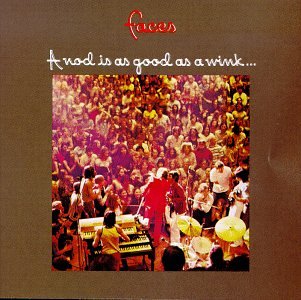
In setting up this Battle Royale, I pledged to center the examination around the music, at least in the early rounds, but before we move on I’ve gotta give Mad Props to the album cover. Here’s a definite, early advantage for the Stones in comparison with the typically blah album covers associated with most of Stewart’s work during this period.
Now…
CRANK IT UP!
Rod Stewart, “Every Picture Tells a Story”
Faces, “Bad ‘n Ruin”
Rod Stewart, “(I Know) I’m Losing You”
Then…
While the Rolling Stones continue to battle Rod Stewart and the Faces in the 1970s and once more find the merits of their later work in question in the Rock Town Hate thread, this seems as good a time as any to take a closer look at the oft-maligned cover of their 1986 Dirty Work album.
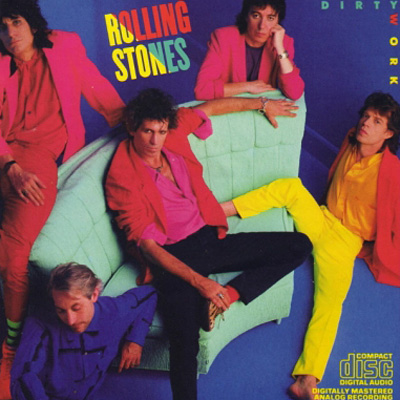
As photographed by Annie Leibovitz, the Dirty Work cover could be viewed as testament of what had gone wrong for the Stones. Lounging about in garishly bright outfits, the band seemed to embody the ideas of 1980s excess and lack of taste. Indeed, this was something of a sign of the times, as the band photo was reportedly a record label mandate, and Dirty Work may have been the first Stones album to be released on both vinyl and compact disc.
Though perhaps not the most popular album cover in the Stones’ catalog, Dirty Work does stand as not just a symbol of the times, but also a commentary on the band itself. As someone once sang, every picture tells a story.
Continue reading »
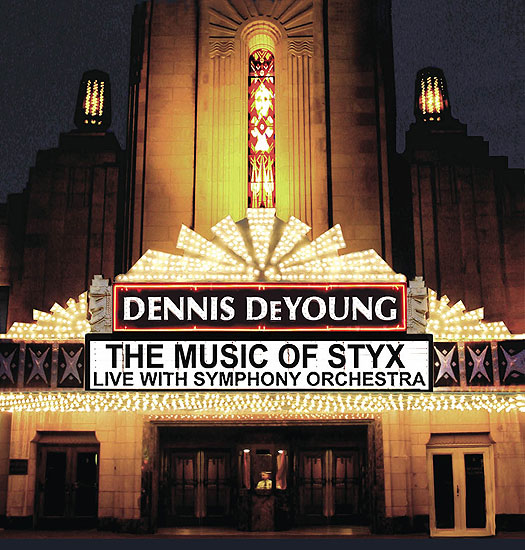
I was out at a baseball game with fellow Townsman Mockcarr the other day, and, as the beer began to flow, we both decided that things at RTH had gotten a bit contentious. What we needed, we agreed, was to find common ground — you know, to find the things we know we can all agree with. We also realized, however, that attempting to find common ground on things we all liked was a fool’s errand. That’s what got us into all this trouble to begin with! A more likely path to peace and harmony, we thought, was finding unity and one-ness in the things we know we all hate.
Townsman Kilroy started things off rather nicely by citing the Rolling Stones’ output, post-Tattoo You. I’m going to suggest Dennis DeYoung. Is anybody here willing to stand up for either of these things and claim they’re not as bad as we think they are? If not, perhaps you’d be willing to help promote the healing by finding something else we can all agree to hate — utterly and completely — together.
Come on, RTH — can’t we all just get along?
HVB
In 1970, the Stones released Get Your Ya-Yas Out! Whether it’s still, as Lester Bangs declared upon its release, the greatest live album ever is open to debate, but most of us would agree it’s by far the best Stones live album – definitely better than the band’s 1970 appearance in Milan, Italy. Check out the live clip that kicks off this round: did they leave Bernard Purdie home for this show?
In terms of this Battle Royale, however, perhaps the most significant development was the actual release date of Rod Stewart’s first album with Faces, First Step, which was mistakenly identified and entered as a 1969 release in Round 1 of our Rod vs Stones, 1969-1976 showdown! This changes the landscape of this contest, relieving the Stones of some body blows in Round 1 while beginning to stack the deck in Rod’s favor in Round 2. Go back and listen to the Faces tracks posted in Round 1 if you don’t think the Stones’ best live album is already suffering in comparison.
Rod Stewart, “You’re My Girl (I Don’t Want to Discuss It)”
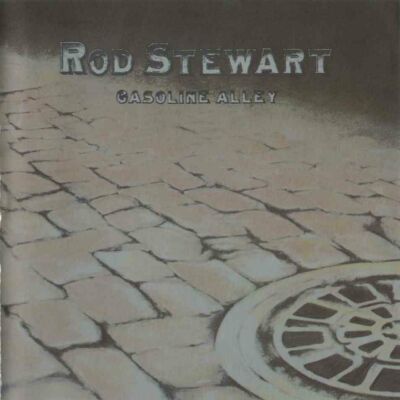
Building momentum for Rod’s 1971 campaign, 1970 also saw the release of Gasoline Alley, the first Stewart-associated release in which the man’s musical personality coalesced, without the residual effects of having recently sung for Jeff Beck’s proto-blooz rock outfit as well as the responsibility of helping Faces fit into the post-Marriott ’70s landscape. The title track, in particular, with its earnest, simple boy’s look back and folky arrangement, marks the beginning of Stewart’s most effective musical personality. Seemingly cognizant of this future analysis, Rod continues to build other pieces in his persona, with covers both the Small Faces‘ “My Way of Giving” (backed by his mates in Faces rather his slightly different backing musicians on the bulk of his early solo albums) and the Stones’ well-known cover of “It’s All Over Now”.
Continue reading »
Although 1969 was one of the more contentious of years for The Rolling Stones, a year in which they lost founding guitarist Brian Jones and, symbolically, lost rock ‘n roll’s innocence at Altamont [a moment of cliched, insincere silence, please], it was a great year for the Stones’ rock ‘n roll output. The band followed up the fantastic “Honky Tonk Woman” single with what I believe is their best album of the Mick Taylor era, Let It Bleed.
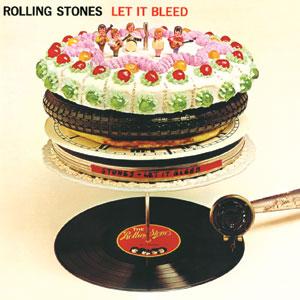
In this opening round of our examination of the musical contributions by Rod Stewart and the Stones from 1969 through 1976, the acknowledged titans of swaggering Anglo-Americana Rock laid down the gauntlet. I don’t need to list the highlights, do I? What I love most about this album is its seamless mix of all that would mark the band’s transition into it’s early ’70s epic status while pushing against the constraints of danceable pop expectations. I think the album is killer rock ‘n roll, and I’ll state up front that Round 1 goes to the Stones.
Faces, “Wicked Messenger”
Rod Stewart, “Street Fighting Man”
Considering we’re booked for an 8-round bout, let’s not discount the body shots landed by upstart Rod Stewart, who by 1969 had set his sights beyond his prominent vocal role with Jeff Beck Group and embarked on the dual tasks of, with Jeff Beck Group bassist Ron Wood, replacing mighty might Steve Marriott in the no-longer small Faces AND becoming a solo star. What bolder way to open these ventures with covers of Bob Dylan and the Stones themselves?
Continue reading »
How would one – me, specifically – go about investigating Duke Ellington? Although he’s constantly cited as one of the greats, I don’t know that I can identify a single recording by the man by tune alone. I have heard of certain tunes, his arranger, and a trusted musician or two – not to mention actually hearing some of his tunes (without really knowing who it was), but I have no clue what it is I’d be looking to check out. I ask because I’m watching my “making of” The Band doc (for the 100th time), and engineer John Simon compared The Band to Ellington and how he used the personalities of the musicians in his band as guides for his compositions. Assuming that it would be worth my effort, is there a collection that might be a best starting place?


