Our ongoing poll to determine the Sexiest Man in Prog-Rock has garnered interest across the globe. Out of the gates it looked to be a showdown between the the Zelig of the Prog/Art Rock world, stylishly tressed bassist John Wetton, and former model and Pink Floyd hunk David Gilmour. Then, without warning, cape-wearing Yes bassist Chris Squire and ELP’s boyishly macho drummer Carl Palmer jumped ahead of Gilmour and put some heat on Wetton. With a record number of votes pouring in, Wetton and Squire are neck and neck! Before more votes are posted, let’s consider the leaders in this heretofore-inconceivable showdown.
I know this discussion will make some of you manly men uncomfortable, but these prog-rock legends aren’t as smooth as Ken dollsdown there, nor are their fans a collection of plastic Ken and Barbie dolls. For the rock ‘n roll record, I suggest you man up and give these gents the once-over they deserve. It’s clear that only Rock Town Hall is fit to determine, once and for all, the Sexiest Man in Prog-Rock. In-depth analyses of our leading vote-getters appear on page 2!
If you’ve yet to participate in one of Rock Town Hall’s patented All-Star Jam, maybe now’s the time!
This is the free-form thread that occasionally appears on The Main Stage, in which Townspeople can share quick thoughts, links, and whatnot regarding not-quite burning issues of possibly fantastic interest to rock nerds like ourselves. For instance, you may want to hip us to as current-day photos of the Leeds University refectory where The Who once rocked their live Tommy jam, giving purpose to at least one teenage guitarist’s life.
You may want to hip us to a pretty funny comedy routine on old rockers and their age-appropriately revised hits.
“Saint John Lennon,” by Raphael Labro (courtesy of http://raphaellabro.com/).
Here’s a helpful new addition to the RTH Glossary, originally courtesy of Townsman pudman13, if short-term memory serves.
Based on the critical Teflon of its namesake, John, the Lennon Pass describes the point when an artist is granted a critical “lifetime pass” for accumulated subpar works based on the emotional/spiritual/humanitarian connection rock fans have with said artist’s landmark works and cultural influence. The Lennon Pass may be thought of as a form of rock ‘n roll sainthood.
There’s nothing necessarily wrong with an artist getting the Lennon Pass. Even music fans who do not particularly care for said artist may admit that the pass is merited. The Clash – and Joe Strummer in particular – are a band frequently cited for getting the Lennon Pass. If she hadn’t done so with the surprising success of Easter, High Punk Priestess Patti Smith solidified her Lennon Pass when she returned from her 40 days and nights in Michigan, having established a family with Fred “Sonic” Smith only to lose him to cancer shortly thereafter.
Perceived martyrdom or any form of death, however, is not a requirement for the Lennon Pass – and I don’t mean to make light of these losses. Despite being a curmudgeonly, overweight artist who’s put out little of real interest in more than 30 years, Van Morrison holds the Pass. Bruce Springsteen is another frequently cited recipient; however, some non-believers go out of their way to question His worthiness. Heck, some rock nerds even go out of their way to tear down the works of Lennon himself.
In extreme circumstances the Pass, once granted, can be revoked. Lou Reed is an example of this, having finally had his Lennon Pass revoked after a career-full of failed attempts at spiting the Lennon Pass Committe when he started parading around with that new tai chi addiction.
Simply being an acknowledged Great Artist and/or wildly popular does not ensure the granting of the Pass. The Rolling Stones, for instance, lost all hope of receiving the pass once Mick Jagger crossed all lines of good taste by appearing on stage in football pants and Capezio slippers and then participating in the so-called “Rock Crime of the Century,” Ja-Bo. Despite their best efforts in the studio and across Third World nations, U2 have been unable to acquire the Lennon Pass.
This is a follow-up to a previous piece on some of the admirable-if-best-forgotten qualities of King Crimson.
As he did in our original clip from 1973, bassist/singer John Wetton, with his flowing man and polyester silkscreened shirt, lays claim to the heretofore inconceivable title of Sexiest Man in Prog. Can you imagine the D&D tail lining up to get backstage after a show?
Can Townsman Northvancoveman or other hockey fans of the Hall confirm if that is actually some form of a Boston Bruins logo on drummer Bill Bruford‘s overalls? It turns out he was wearing that thing in the earlier clip, but I didn’t notice the logo. Bruford must have been sweet on that outfit.
And thinking of a recent thread, is that a xylophone or a marimba I see behind Bruford?
Violinist David Cross seems to be wearing the same suit as in our original feature, but his haircut suggests a coming client meeting for his day gig. The guy cleans up nicely!
Robert Fripp is still the brains of the operation, making no effort to get in step with the latest styles. It’s cool, though: he usually stays in his office, wrapped up in his latest designs and out of our hair. Bruford and Wetton will pitch any new capability Fripp cooks up.
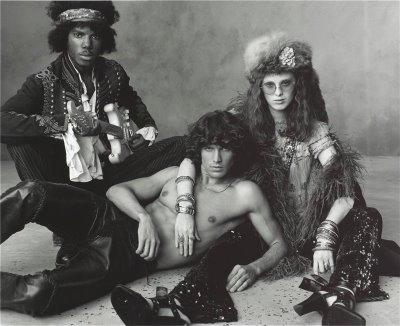
What if founding “27 Club” members Janis Joplin, Jimi Hendrix, and Jim Morrison lived long enough to each make a celebrated comeback album? Let’s say they went through the standard cylce of rock bottom, rehabilitation, humility and self-awareness, and finally a well-crafted, highly acclaimed comeback album produced by the likes of Rick Rubin and T-Bone Burnett. What would these comeback albums sound like? Who would produce each one? What guest star would be featured on the lead single?
Bonus question: What instrument would Brian Jones be featured playing on Kurt Cobain‘s comeback album?
Quick thought following about 3 minutes of reflection: I’m reading this Slate piece on the partnership of Lennon and McCartney, and my mind started drifting to the wealth of fantastic English bands vs the wealth of fantastic American solo artists.
Think about the titans of rock ‘n roll (and country and soul, in the case of America): Americans gave the world Elvis, Chuck Berry, Bob Dylan, James Brown, Aretha Franklin, and Johnny Cash, among other major solo artists. England gave the world David Bowie and…Donovan?
When it comes to bands, though, England gave us The Beatles, The Rolling Stones, The Kinks, The Who, The Clash… America gave us The Beach Boys and…The Byrds?
Does the wealth of legendary American solo artists (and dearth of legendary American bands) have something to do with our independent pilgrim/cowboy spirit? Does the converse concerning English musicians have something to do with their spirit? Am I overlooking American bands at the usually acknowledged top level? Am I overlooking English solo artists at the usually acknowledged top level? Am I really going to have to hear it from Ramones and Scott Walker fans?