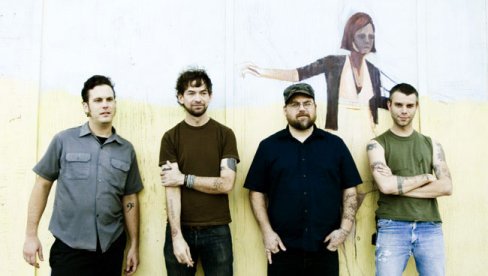
Tags: replacements
What Is Fantastic Songwriting and How Can I Spot it on an Album with a Production That I Cannot Stomach?
By Mr. Moderator on Aug 12, 2009

In a recent thread on bands that were irrevocably weakened by the loss of a key member, Townsman jungleland2 made an interesting comment:
I too call Bullshit on Bob Stinson. Paul played most of the guitars anyway. Slim Dunlap gave them a new more textured sound. Don't blame the strange late 80's production of Don't Tell al Soul..the songs are fantasic.
What interested me most was the last part, about the songs on Don't Tell a Soul being "fantastic" despite the album's generally acknowledged bad production. I've never been a Replacements fan, so I'm not equipped to argue whether the songs are on par with their more beloved works or not, but I'm scratching my head at the moment, asking myself if I own any records with songs that I believe are "fantastic" despite production that I don't like. If I like the production of an album I feel fit to judge the quality of the songwriting, however if I really don't like the production of a record I don't have a clue as to how to judge the songwriting.
I'm reminded of the thing people say about flawed films that have "great scripts." Do these people get a copy of the script handed to them when they sit down to watch a film? Why can't I ever tell anyone about the "great script" behind a poorly made film? I know a lot more about music than I do film, but I wonder: Am I so tied to the sound of records that I can't tell if the song itself is actually good? How about you?
If you have examples of fantastic songwriting smothered by production you can't stand (as opposed to lo-fi production, for instance, that you may like despite it being considered technically deficient), I'd love to hear them. Most importantly, for my growth as a human being, I'd like to hear how you managed to discern the nuggets of nutrition within the aural turds.
I look forward to your comments!
Baby Got Back - Album Covers Are Only Half the Story
By sammymaudlin on Aug 7, 2009
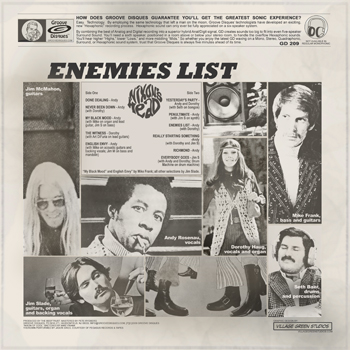
Recently I had the pleasure of being contracted to design the art for the latest release by Philly phaves, Nixon's Head. The Enemies List (available for purchase here) cover was an exercise of almost pure creativity. Listening and then designing.
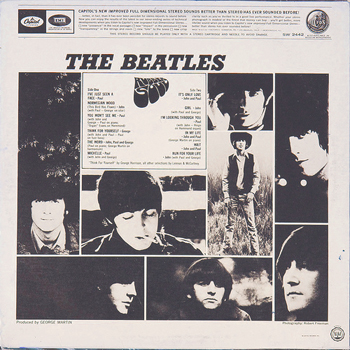
The back cover though was a joy for different reasons. The band wanted the back to be a take on the back of The Beatles Rubber Soul. (I derive an odd pleasure from finding/duplicating just the right font.)


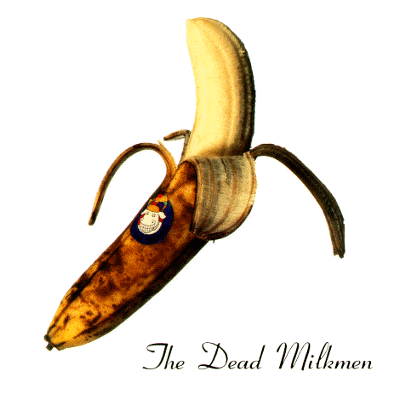
This got me thinking about album parodies and more specifically album backs. There are loads and loads of album parodies. Not the least of which include Townsman mrclean's band, The Dead Milkmen's Smokin' Banana Peels cover:

Lucero
By 2000 Man on Nov 26, 2008

I’ve written this three times, because it’s always way too long for RTH, and way too fawning for me. Maybe Mwall’s “tuneless” comment is intimidating me! I found out about Lucero from a one=word post on a message board that answered the question, “Where does a Replacements fan go in this century?” A one-word answer that seemed so sure, stuck in the middle of a bunch of posts that lamented the loss of The ‘Mats and the usual, “Rock is dead now,” crap that every generation seems to say when they get bored with rock n roll seemed to say it all. “Lucero.” I was intrigued.
I missed The Replacements. I had some Uncle Tupelo cd’s while they were a functioning unit, but never saw them. I found out about Whiskeytown when Stranger’s Almanac came out, and again never saw them. I completely missed Jawbreaker. I found Lucero’s latest album (at the time) in Massachusetts the week it came out. The kid at the counter asked me who they were and I just said, “I dunno. I hope they’re good.” The album was That Much Further West and as it turns out, guitar player Brian Venable isn’t on it, and he’s a main reason I’ve come to like all their other albums more than the one I initially found. I’ve seen them several times, the first time all by myself. The last time I had six other people with me. They were my band, then they were our band. They aren’t quite everyone’s band, and maybe that will never happen. I hope it does for them, but if it doesn’t I already know that their albums aren’t the kind that sit on my shelf for years between plays, and I know in 20 years I’ll still feel lucky to have their music.
Where does Jawbreaker fit in all this? The other bands I mentioned have that Americana vibe, and share a knack for decent lyrics and nice turns of phrase. Jawbreaker shares that lyrical sensibility, and while their sound musically leans more punk than country, Lucero are big fans and Jawbreaker shares as much in their influences as The Replacements or Uncle Tupelo. The Jawbreaker song "Kiss the Bottle" is always a highlight when they play it live. I bet some of their fans think it’s a Lucero song. Their live shows are always fun, and the band can range from super tight to drunk and sloppy all in the same song, but that’s how bands that I like tend to play. I think for some of Lucero’s fans, their nods to Jawbreaker and The Replacements are just one more thing that brings them closer to their fans.
Jawbreaker – "Kiss the Bottle"
Lucero – "Kiss the Bottle"
Wanna hear someone famous miss the point?
Mr. Mod Has Left The Building: Let's Talk Replacements, Twin Tone & Bonus Tracks
By sammymaudlin on Jul 29, 2008
TWOFER TUESDAY
Mr. Moderator is on vacation and rarely checking in. I love the man, but I don't think I can suffer through another tirade about lack of musicianship or "crappy 70s music values" so let's us Replacements fans discuss the superior Twin Tone years and bonus tracks whilst the cat is away.
My appreciation for The Replacements may be almost as divisive as Mod's. As far as I'm concerned, they ceased to exist as a great band the day Bob Stinson "left" the band. I know Bob largely sucked as a guitar virtuoso but it was his reckless rock 'n roll 'tude that was so, so necessary in postponing Westerberg's "I'm an artist" 'tude that eventually wore thin with me.
That's not to say that there isn't any post-Tim stuff I like, I do, it's just not The Replacements.
I dig the band! So, like many fans, the only potential lost treasures were to be found on Twin Tone, with the exception of a few rare moments on the All For Nothing comp:
Paul Westerberg's 49:00: A Sorta-Instant Review
By Oats on Jul 23, 2008

In a move that happened too fast for most online music news sources to notice, Paul Westerberg released a new, online-only album today, 49:00, for only 49 cents.
Follow the relevant link on the fan site Man Without Ties for the details. At this point, it's available from Amazon.com and something called Tunecore.com, apparently the only sites that would agree to the 49-cents thing.
Of course, with Westerberg there's a catch. You get all the songs in one big MP3 file, and no indication of song titles. (Although another fan site made pretty good guesses.)
There's plenty of other curve balls. Firstly, it's only 43:55 minutes. 49:00 at times sounds a bit like an old TDK blank tape he saw fit to cram with as many songs and scraps as he could on one side. Some songs begin just before the prior ones abruptly end. Occasional six-second splurges of unrelated songs bridge one "proper" song to the next. You might think this is Westerberg being lazy, but I don't.
Like everything he's released this decade, except the Open Season soundtrack, this album is a one-man-band-in-his-basement affair. When he first unveiled this new direction, on 2002's awesome Stereo/Mono, he seemed to hit upon way to treat lo-fi as a sonic value. It's as if he realized he could get a better, more unique sound on his own, with rudimentary engineering skills. Rather than hire a bunch of session hands to try and fail to re-create, say, the classic Stones sound, he himself tried and failed to re-create the classic Stones sound. In the process, he found a cool sound all his own.
Based on one listen, 49:00 could be the next step for Westerberg's evolving aesthetic. The album functions equally well as an endearingly sloppy take on Let it Bleed and Gasoline Alley, or a musique concrete deconstruction of itself.
My take on Westerberg, which has no basis in any real interaction with the man, is that he's a lot like Neil Young: A curmudgeonly control-freak perfectionist who wants, no demands, that things sound messy. He wants that off-the-cuff one-take vibe, and has little or no compunction about dropping your ass if you can't supply it. I'll admit, it can provide a listener with a severe case of cognitive dissonance at times. But it also allows him to tap into that devil-may-care, funny streak that made The Replacements so endearing to a lot of people.
It ain't Loser Rock, that's for damn sure!
Loser Rock
By Oats on Sep 17, 2007
For many on RTH, Loser Rock is the ultimate musical bete noire. On the face of it, the words “Loser Rock” conjure the image of a broken, simpering man, venting his pain by cradling an acoustic guitar, mousily whispering words of a bottomless yet superficial despair, before finally collapsing in a pile of tears. Or perhaps the term summons the memory a doomed, slovenly, possibly soused twentysomething, howling against the elements, wringing a tortured sound from his Fender Jaguar, while a rhythm section plods along with a distinct lack of commitment.
Here in the halls of rock, Loser Rock can take on mythic proportions, often becoming the convenient scapegoat for the decreased popularity of party-rock, cock-rock… in fact, one could conceivably pin the decline of rock ‘n’ roll in the public sphere at the feet of Loser Rock. The ultimate sin of Loser Rock is that it ultimately encouraged listeners to equate rock with bad times, not good ones. And who honestly wants spend time at that party?
But of course in many ways this characterization of Loser Rock is a straw argument. Re-read the first paragraph; now, do you actually know any well-known musicians who are really like that, and nothing but that? I submit that the likes of The Smiths, Elliott Smith, and Belle and Sebastian are not Loser Rock so much as they are Alone Time Rock. (Paradoxically, The Smiths and Belle and Sebastian’s cult audiences have swelled to the size of their own social sect, practically. Of course, these fans are often cited as part of the problem by the anti-Loser Rockers. But that’s a whole other essay.)
That said, there is something called Loser Rock and it can be a positive or a negative. At its best – when acts like The Replacements, Aimee Mann, Nirvana, and Quasi are firing on all cylinders – Loser Rock owns up to reality. If Winner Rock thrives on the delusion that the odds can be defied (hence its frequent connection with sports), Loser Rock achieves catharsis by facing failure and articulating it accurately and perfectly. Sometimes, shit goes down and it’s best not to pretend otherwise. Loser Rock can allow you to wallow, and sometimes we all need a good wallow. But that’s not the only way. For a time, The Replacements showed us how to turn losing into a good party. Aimee Mann displayed the effectiveness of a precisely worded and dryly delivered summation of a losing situation. Nirvana wedded hopeless desperation to corrosive guitars and a rhythm section that frankly eats Winner Rockers for dinner. Quasi have entire albums that act as the indie-rock equivalent of Peter Finch’s famous Network speech, or perhaps Alec Baldwin's in Glengarry Glen Ross. Get mad, sons of bitches.
In contrast, it seems to me, Winner Rock as Mr. Moderator defines it, is an almost abstract concept. The Clash addresses its audience as a whole? Doesn’t this tie in with that great band’s worst attribute – their rhetoric? I’m not convinced that Winner Rock is not, in fact, best represented by Survivor and Journey.
One final point, and an olive branch of sorts: An appreciation of Loser Rock does not mean one cannot also listen to Winner Rock. The point is that a person should be able to access a wide variety of emotions in their music collection, if they so choose. One day you might want to hear “Eye of the Tiger.” Another day you might want “Needle in the Hay.” Must every song be connected to “Satisfaction”?
More With Less
By Mr. Moderator on Jul 12, 2007
I was listening to some of my favorite rockin' Mott the Hoople songs today - early period stuff like "Death May Be Your Santa Claus", "Walkin' With a Mountain", and "Rock 'n Roll Queen", and I got to thinking about artists who do much more than could be expected with the little bit they've got. No offense to Ian Hunter and his fine, rockin' mates, but with the exception of the Bowie-penned "All the Young Dudes", "Roll Away the Stone", and maybe one or two other songs, Mott the Hoople made their career on exactly two types of songs:
Deal Breaker: Bob Stinson
By Mr. Moderator on May 25, 2007
Among the dozen Replacements songs that I enjoy hearing (probably 8 of which follow the same heroic-yet-self-deprecating template) is "Can't Hardly Wait", from one of two of their albums that I like the most, Pleased to Meet Me (wanna take a stab at what the other one is?). It's got that Booker T & the MGs riff, which I'm always a sucker for, and I like the melody and sentiments of the lyrics. Goes down easy.
A couple of days ago I heard an alternate version that I never knew existed. Bob Stinson played on it, driving the song with his customary music store test-run bravado. Just like that a different version of the same song that I'd liked by The Replacements moved to the Crap bin. And I was reminded that Bob Stinson was the deal breaker for me regarding The Replacements. There were enough other beefs I had with them that they wouldn't have made it beyond third-rate status with me, but I might have enjoyed them more had they made more records without Stinson - and without that Slim Dunlap guy as well. I don't think Westerberg was very creative or effective in the "giving direction" department. On either side of Pleased to Meet Me, he let his guitar store clerk guitarists just do their thing, and their thing belonged in the guitar aisle.
So this is a roundabout way of asking whether you've ever identified a deal breaker among a band that you otherwise might have liked well enough.
Obsessed With Reading: Rock Biographies
By sally_cinnamon on Mar 6, 2007
One of my favorite rock biographies that I've ever read is a dog-eared copy of a book penned by former road manager Johnny Green & Garry Barker called, A Riot of Our Own: Night and Day with the Clash. I've passed this one on to friends and gotten it back by mail with compliments more than a few times in the past from touring bands, giving it out with the promise of a (hopeful) return. Each time someone spots it, I have the urge to give it away just so that it can be read and enjoyed by someone else.

A Riot of Our Own: Night and Day with the Clash by Johnny Green, Garry Barker
It's made it into my all-time favorite rock biographies because of its ability to grab hold of my imagination no matter what part of the book I open a page to - The Clash in the late 1970s. Watching Rude Boy always kind of gave me that feeling too and I think that's where this book got me as well - it sucked me right in through the eyes of Someone Who Was There, possibly getting spit on, sweat on and kicked, but there - sleeping in the tour bus, and knee-deep in the chaos. It made me feel like I was part of the crew, along for the ride. No BS, and a really strong narrative!

The Replacements' Let It Be (33 1/3) by Colin Meloy
Another cool collection that I highly recommend, not necessarily all "rock biography" per se, but still worth a mention, are the books from the 33 1/3 series. I've only read The Replacements' Let It Be, by Colin Meloy (lead singer for The Decemberists), but thoroughly enjoyed it, and I plan to pick up others. Meloy's touching and personal essay detailed how hearing The Replacements album Let It Be impacted his life and that of his best friend in his early teens.